How New AI Employees Can Continue Existing Work Using SIMI
AI models continue to evolve, and newer model versions may become available through your API provider.
But what happens to work that was already completed using an older AI model?
In SIMI, an existing employee conversation can be shared with another employee so the work can continue.
This is the workflow we demonstrate in Part 5 of the Veridata series.
Watch the video above to see Part 5 of the Veridata AI company demonstration in action.
Why Continue Existing Work?
Suppose you created an employee agent using an older model version.
Later, a newer model version becomes available.
Instead of completely restarting the workflow, you can continue the existing conversation using another employee.
This can help you take advantage of newer AI versions while continuing existing work.
Sharing the Field Enumerator Conversation
We begin by going back to the Chats section.
We select the Field Enumerator.
We then click Share in the top-right corner.
The conversation is shared with:
Field Enumerator 1, Field Enumerator 2, Field Enumerator 3, Field Enumerator 4, and Field Enumerator 5.
The existing conversation can now be continued by the selected employees.
Continuing with Field Enumerator 1
We return to the Shared Chats section.
We select Field Enumerator 1.
Our goal is to continue the existing Field Enumerator conversation.
We select the conversation and click Merge.
When the conversation appears on the screen, we click Continue in the top-right corner.
Sending the New Command
We then type the command and click Send.
Field Enumerator 1 processes the existing conversation.
As shown from the response, Field Enumerator 1 has successfully continued the Field Enumerator conversation.
The previous work has therefore been carried forward into the new employee's workflow.
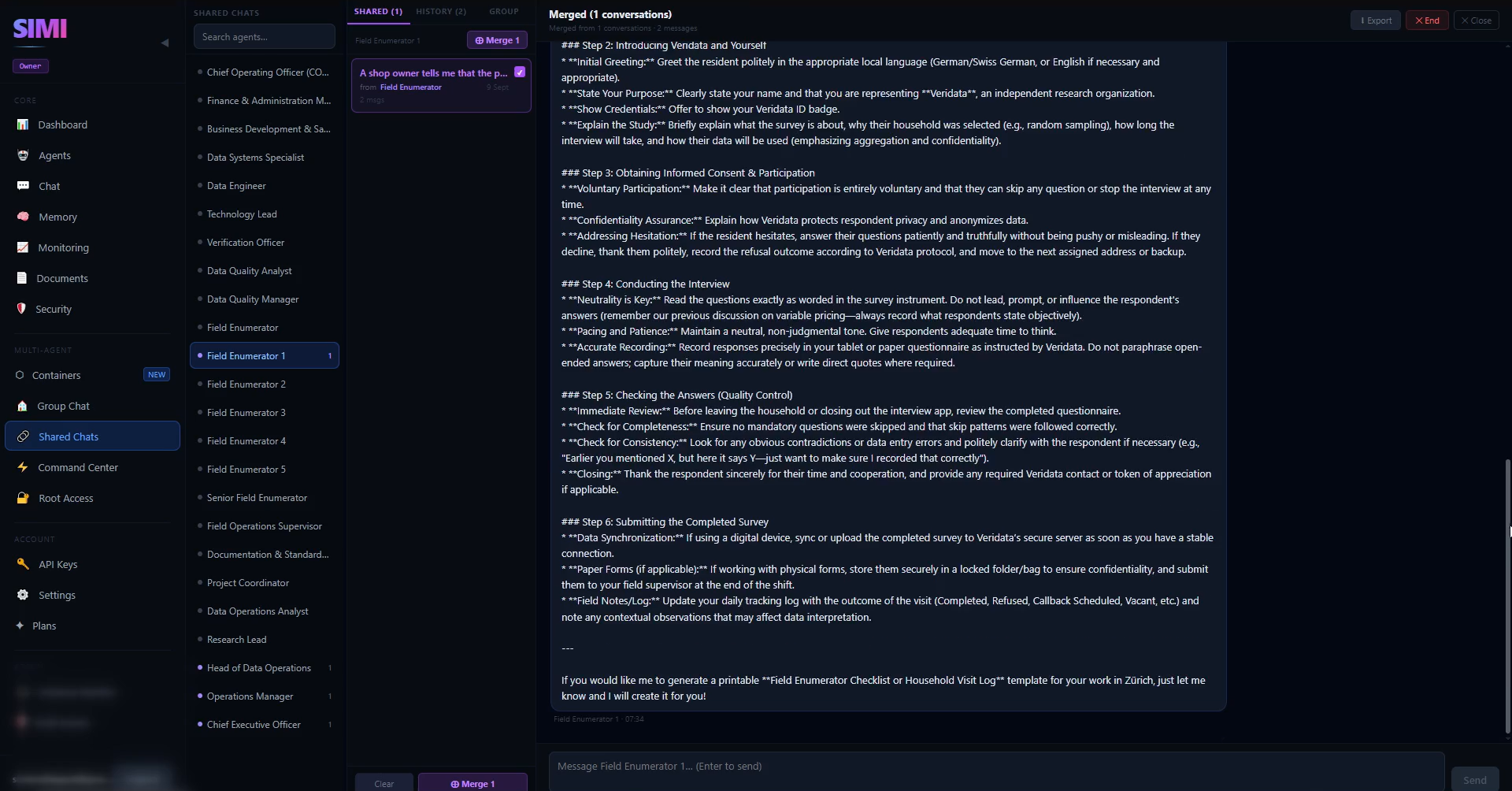
Field Enumerator 1 picking up the merged Field Enumerator conversation and continuing the existing work.
Using New AI Model Versions
This approach can be useful when you want to take advantage of new AI model versions provided through your API provider.
If an employee was originally created with an older version, you can continue the conversation with a newer version.
This creates flexibility when managing an AI workforce over time.
Preserving Existing Context
Starting a new conversation from scratch can mean losing the context of previous work.
Continuing a shared conversation allows the new employee to work from information that already exists.
For an AI company, this can be particularly useful when tasks develop over multiple stages.
AI Employees Can Take Over Work
The workflow also demonstrates another important idea: one AI employee does not have to remain responsible for a conversation forever.
Work can move to another employee.
A newer employee can take over an existing conversation.
This allows the AI workforce to remain flexible.
Conclusion
Part 5 demonstrates how SIMI allows new AI employees to continue existing work.
We share a Field Enumerator conversation with five additional employees, select Field Enumerator 1, merge the conversation, continue it, and assign a new command.
As demonstrated, the existing conversation can successfully continue with the new employee.
This creates a practical way to maintain workflow continuity while also allowing the use of newer AI model versions.
Build Your Own AI Company with SIMI
Create personalized AI employees, assign their roles, and start building your own AI-powered company inside SIMI.
Explore SIMI