How to Assign Tasks to AI Employees Using SIMI
Creating AI employees is only the beginning.
Once an AI workforce has been created, those employees need to be given meaningful work. In SIMI, you can provide instructions to individual AI employees based on their specific roles and responsibilities.
In our Veridata demonstration, we created 24 AI employees. In this stage, we begin assigning their first tasks and reviewing the responses they provide.
Watch the video above to see Part 2 of the Veridata AI company demonstration in action.
Starting with the CEO
We begin by selecting the Chief Executive Officer.
We enter the task inside the chat area, making sure the instructions are clear and specific to the CEO's responsibilities.
We then click Send to assign the task.
The AI employee processes the instruction and produces a response.
Reviewing the CEO's Response
After the CEO responds, we review the result.
The purpose of the review is to determine whether the response meets the goals and objectives we have established.
If additional work is required, we can provide further instructions in the future.
This means an AI employee's work can continue beyond a single prompt.
Assigning Work to the Research Lead
Next, we select the Research Lead.
We enter clear instructions related to research and click Send.
The Research Lead then processes the task according to the instructions and its assigned role.
We review the response to determine whether the work meets our objectives.
This demonstrates how different employees can be assigned different types of work.
Assigning Work to the Project Coordinator
We then select the Project Coordinator.
We provide task-specific instructions and click Send to begin the work.
After receiving the response, we examine it to determine whether it meets the objective.
Each employee can therefore receive instructions that are appropriate for its individual responsibilities.
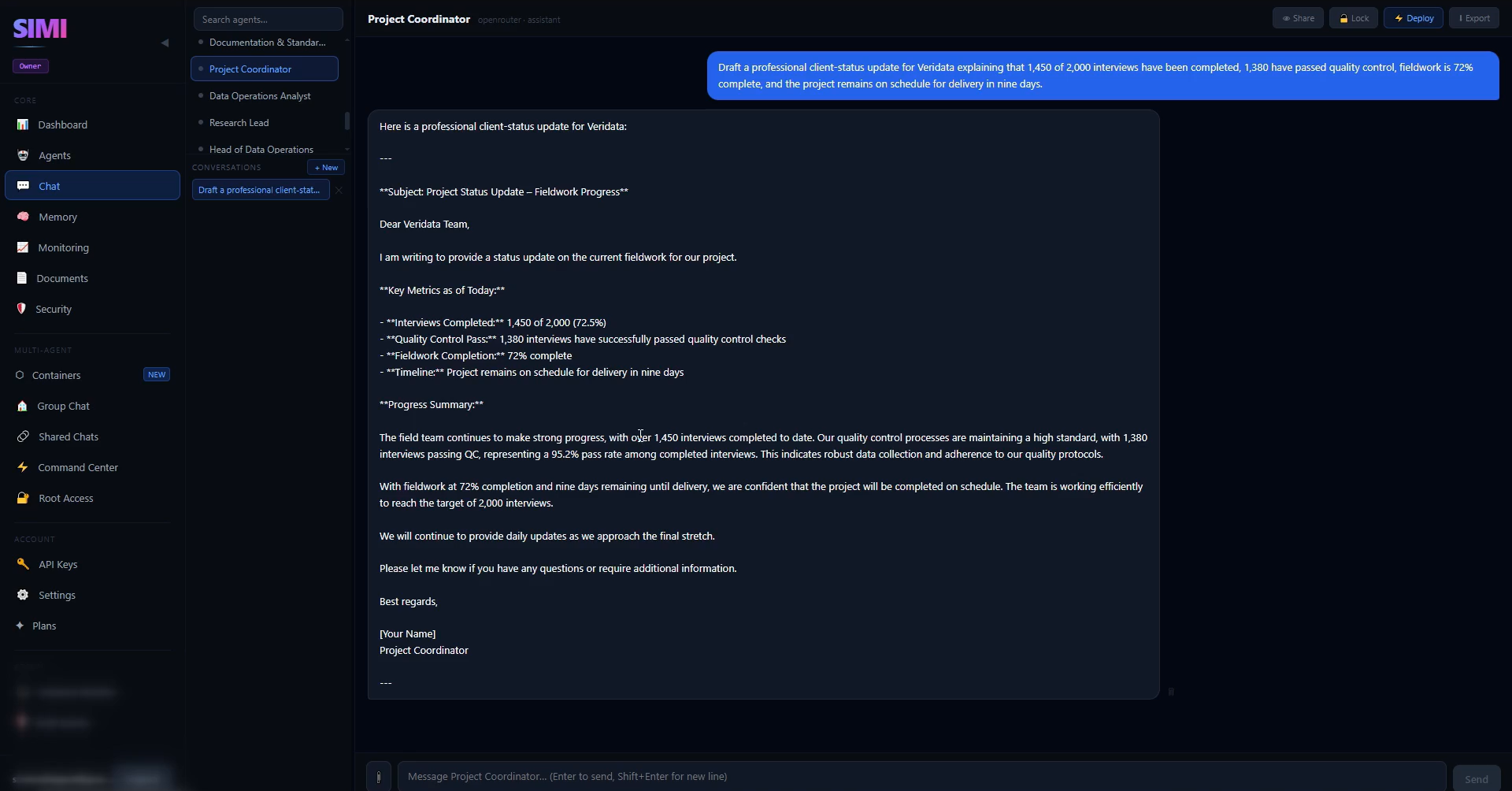
The Project Coordinator drafting a client-status update after receiving a task-specific instruction.
Assigning Tasks to the Remaining Employees
Once the task-assignment process has been demonstrated, we can quickly assign tasks to the remaining 21 employees.
Each task can be tailored to the employee's role.
This is important when building a structured AI workforce because employees should not necessarily receive identical responsibilities.
The CEO, Research Lead, Project Coordinator, Field Enumerators, sales employees, data employees, and other workers can all receive instructions relevant to their positions.
Reviewing AI Work
Reviewing the result is another important part of the workflow.
We can examine the response and determine whether it meets the intended goal.
This allows us to guide the employee further whenever necessary.
Additional instructions can be provided in future conversations as the company's needs change.
Creating a Working AI Organization
Task assignment turns the 24 personalized agents into an active workforce.
The employees are no longer simply configured roles. They are now performing work according to their assigned responsibilities.
This creates the beginning of an operating AI company.
The workflow can continue from individual tasks into more advanced processes where multiple employees work with shared information.
From Individual Work to Collaboration
Individual task execution becomes especially important when later workflows depend on information produced by employees.
An employee's response can be shared with colleagues.
Multiple conversations can be merged.
Senior employees can review the work.
Groups can be created.
Employees can even continue conversations started by another employee.
Therefore, assigning tasks is an essential building block for the larger AI company workflow.
Conclusion
In Veridata, we begin by assigning tasks to the CEO, Research Lead, and Project Coordinator.
We enter role-specific instructions, send the tasks, and review the resulting responses.
We then extend the same process to the remaining 21 employees.
This establishes the foundation for a structured AI workforce where each employee can receive work according to its role and responsibilities.
Build Your Own AI Company with SIMI
Create personalized AI employees, assign their roles, and start building your own AI-powered company inside SIMI.
Explore SIMI